
Call us anytime
STEM Toys That Build Real Skills: Picks by Age

Last updated: November 6, 2026
The best STEM toys are open-ended toys that make your child build, test and fix something: building sets, snap-together circuit kits, marble runs, logic puzzles, coding robots, microscopes and real science kits. Pick by skill, not by the label alone. The American Academy of Pediatrics (AAP) says "the best toys are those that match children's developmental skills and abilities and further encourage the development of new skills." Then check the safety basics. U.S. law bans small parts in toys for children under 3, and every toy made after April 20, 2024 must meet the federal toy standard, ASTM F963-23. Below: what each kind of toy teaches, picks for ages 3 to 14, the safety rules to check, and how to tell when your child is ready to move from kits to real projects.
The best STEM toy is the one that makes your child ask a question the box cannot answer. Send me project ideas from our PhD mentors →
What skills do STEM toys build?
Each kind of toy trains a different skill. Match the toy to what your child enjoys and what you want to grow.
| Kind of toy | Main skill it builds |
|---|---|
| Blocks and magnetic tiles | Spatial reasoning, balance, early geometry |
| Logic puzzles | Planning several steps ahead, persistence |
| Marble runs | Cause and effect, gravity, design and redesign |
| Snap-together circuit kits | How electricity flows, reading a diagram |
| Coding robots | Sequencing, debugging, logic |
| Microscopes and magnifiers | Close observation, recording what you see |
| Chemistry and crystal kits | Following a procedure, measuring, safety habits |
| Telescopes | Patience, observation, astronomy |
The federal toy standard includes age-grading labels, so always follow the age printed on the box. The AAP's clinical report on toys adds two points that matter more than any category:
- Play together. "The most educational toy is one that fosters interactions between caregivers and children in supportive, unconditional play."
- Simple often wins. "A good toy does not have to be trendy or expensive." Blocks and puzzles, the AAP notes, "can support fine motor skills, cognitive and language development, and early spatial skills and math."
STEM toys for ages 3 to 5
At this age, your child learns by handling, stacking, sorting and knocking down. The best toys have no single right answer.
- Building sets and magnetic tiles. These teach shape, balance and symmetry. Example: the Magna-Tiles Classic 32-Piece Set, which the manufacturer lists for ages 3 and up.
- Simple puzzles and pattern games. These build early math: matching, counting and spotting what comes next.
- Large magnifying glasses and nature tools. A bug viewer and a magnifier turn a backyard into a lab.
- Screen-free coding toys. Toys that your child programs with buttons or cards, not a screen, teach "first this, then that."
Keep it hands-on. HealthyChildren.org, the AAP's site for parents, notes that "children and adults talk less when they play with electronic toys." Ask "What will happen if...?" and let your child test it.
Safety at this age: toys for children 3 to 5 that contain small parts must carry the warning "CHOKING HAZARD - Small parts. Not for children under 3 yrs." If a younger sibling shares the playroom, store those toys out of reach.
Every scientist starts with "What will happen if...?" Picture your child asking it at the kitchen table tonight. Send me simple experiments to try at home →
STEM toys for ages 6 to 8
Your child can now follow multi-step instructions and wants toys that actually work.
- Marble runs. Your child designs a track, watches it fail, and fixes it. That loop of design, test and redesign is the core of engineering. Example: the GraviTrax Starter Set, which the manufacturer lists for ages 8 and up, with over 120 parts.
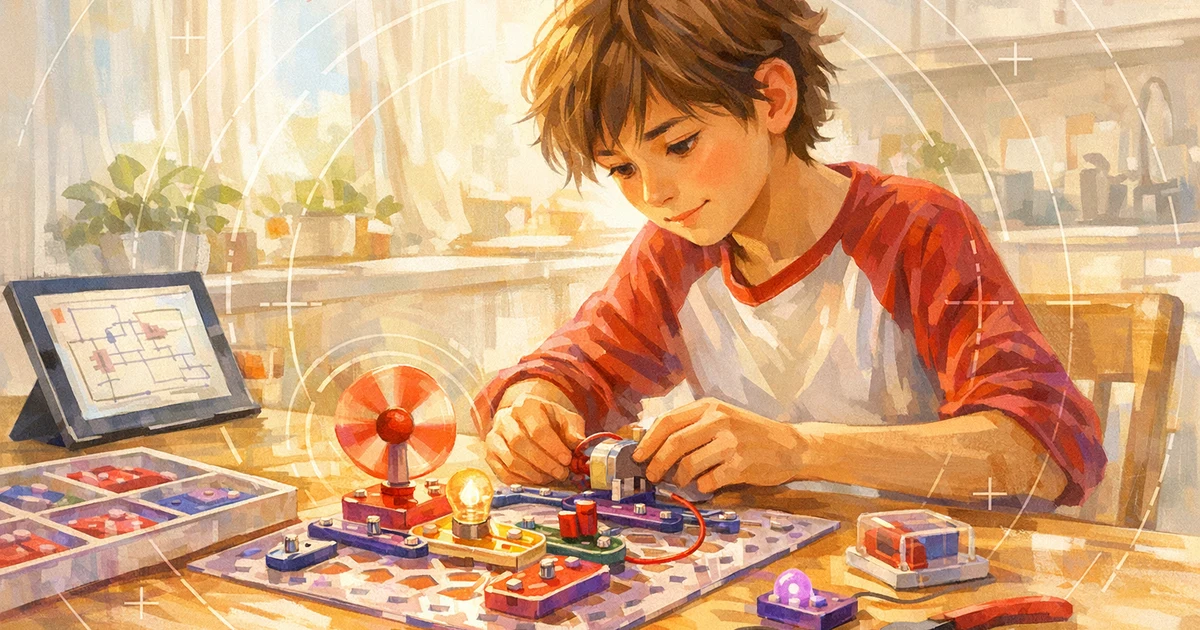
- Snap-together circuit kits. Parts click onto a board with no soldering or tools. Example: Snap Circuits Jr., listed by the manufacturer for ages 8 and up, with 30 parts and over 100 projects.
- Coding robots. Your child gives a robot a sequence of commands and then debugs it when it goes the wrong way.
- Beginner science kits. Crystal growing, simple chemistry with kitchen-safe materials, and magnet experiments.
Both example kits start at age 8. For a 6- or 7-year-old, look for simpler versions, or build alongside your child.
Safety at this age: toys for children 3 to 7 that contain small balls or marbles must carry a choking warning, and so must latex balloons. The toy standard allows strong small magnets only in "educational toys intended for children aged 8 and older," and only with a warning label.
STEM toys for ages 9 to 11
This is the age when toys can become real tools. Your child can handle more complex instructions and can start to run small experiments.
- A real microscope. Choose one with glass optics and a light, plus blank slides so your child can prepare samples.
- Chemistry kits. Pick a kit with a clear manual, safety goggles and experiments that ask your child to predict before mixing.
- Programmable robots. Look for robots that start with block coding and can move to text coding later, so the toy grows with your child.
- Logic puzzles. Example: ThinkFun Rush Hour, listed for ages 8 to 99, with 40 challenges from beginner to expert.
- A telescope. A simple, stable telescope and a star chart teach patience and observation.
Add one habit at this age: a lab notebook. Ask your child to write the question, the guess, what happened and why. That habit turns play into science. A science fair is a natural next step. See science fair project ideas for middle school.
STEM toys for ages 12 to 14
By 12, many bright children have outgrown the toy aisle. The best "toys" for this age are real tools: electronics kits with microcontrollers, text-based coding, a better microscope or telescope, and model rocketry with an adult.
Read labels closely. The federal toy standard covers toys for children under 14, and independent lab testing is required only for products intended mainly for children 12 and under. Many products for teens are sold as hobby or craft items, so follow the manufacturer's instructions and supervise anything with chemicals, heat or power tools.
At this age, the bigger change is not the toy. It is the question. A kit tells your child what to build. A project asks your child to decide what is worth finding out.
At 12 to 14, curious children are ready for questions with no answers in the back of the book. Send me insider ideas for curious 12-to-14-year-olds →
How to choose a STEM toy
Use five checks before you buy:
- Match your child's skills. Pick a toy that is a small stretch from what your child can do now. For safety, never go below the age on the box.
- Choose open-ended over one-and-done. A set your child can rebuild many ways teaches more than a kit that makes one thing once.
- Choose toys that grow. The AAP recommends toys "that will grow with the child" and "encourage exploration and problem-solving."
- Play together at first. Your questions teach as much as the toy.
- Judge by use, not claims. The AAP notes that "many claims advertised for toys and apps are not based on scientific evidence."
STEM toy safety rules every parent should know
The AAP is direct: "just because a product is on the market does not mean that it is safe." These are the federal rules from the U.S. Consumer Product Safety Commission (CPSC), and what each means at home.
- No small parts under 3. Toys for children under 3 cannot contain small parts (16 CFR part 1501). A small part is anything that fits in a test cylinder 2.25 inches long by 1.25 inches wide, about the size of the expanded throat of a child under 3. CPSC warns that a toilet paper roll "is wider and longer than the official tester," so it is not an exact check.
- Choking warnings for ages 3 to 7. Toys for children at least 3 but under 6 with small parts must carry a choking warning. Toys for children at least 3 but under 8 with small balls or marbles must too (16 CFR 1500.19).
- The federal toy standard. ASTM F963 is mandatory for toys, which the CPSC defines as playthings for children under 14. Toys made after April 20, 2024 must meet ASTM F963-23 (16 CFR part 1250).
- Magnets. Strong small magnets are allowed only in educational toys for ages 8 and up, with a warning. The AAP reports that swallowed high-powered magnets have caused serious harm to children. If you think your child swallowed a magnet, get medical help right away.
- Button and coin batteries. Reese's Law (16 CFR part 1263) protects children 6 and younger from swallowing these batteries. The toy standard requires toys to keep children from reaching batteries during play. Check that battery covers stay shut.
- Water beads. A federal water bead standard took effect March 12, 2026. Water beads made after that date must stay small when expanded, limit acrylamide and carry warnings. Keep older water beads away from young children.
Before you buy, look up the product on Recalls.gov. If a toy breaks in a dangerous way, report it on SaferProducts.gov. The AAP's toy report recommends both sites.
When is your child ready for real projects?
Toys teach skills. Real projects teach your child to ask a question that no box has answered. Watch for these signs:
- Your child finishes kits fast, then changes the instructions to see what else will happen.
- Your child asks questions the kit cannot answer. "Why does this crystal grow faster in the window?"
- Your child designs experiments, with a guess, a test and a result.
- Your child stays with one topic for weeks or months.
These are also common signs of a gifted learner who needs more challenge. See signs of giftedness in teenagers and how to challenge a gifted child.
The next step after kits is a real question and a real project, with someone who knows the field. For ages 11 to 14, that can be a science fair project, a school gifted and talented program, or a research project guided by a mentor. For the options, see programs for gifted middle school students and how to get into research in middle school.
In the STEM Explorers Program, your child chooses a question in a field they love and works on it one-on-one with a PhD mentor from a top-20 university. Your child finishes with a project they are proud of and a clear idea of what to explore next.
Your child has outgrown the kit. The next step looks less like a toy and more like a lab notebook. Show me what comes after the kit →
Frequently asked questions
What is a STEM toy?
A STEM toy invites your child to use science, technology, engineering or math: to build, measure, test, code or observe. Open-ended toys like blocks and marble runs count as much as kits labeled "STEM."
What are the best STEM toys for a 5-year-old?
Building sets, magnetic tiles, simple puzzles, magnifiers and screen-free coding toys. Play together and ask your child to predict what will happen.
Are STEM toys worth it?
The skill comes from how your child plays, not the label. The AAP says a good toy "does not have to be trendy or expensive" and that simple toys like blocks and puzzles support early spatial skills and math.
Are magnetic toys safe?
Toys that meet the federal standard limit strong small magnets to educational toys for ages 8 and up, with warnings. Keep magnet toys away from younger children and get help at once if one is swallowed.
Sources
- AAP, Selecting Appropriate Toys for Young Children in the Digital Era, Pediatrics (2019)
- AAP News, Best toys for children's development
- HealthyChildren.org, Toy Buying Tips for Children with Special Needs
- eCFR, 16 CFR Part 1501, Small Parts
- eCFR, 16 CFR 1500.19, Choking Hazard Labeling
- eCFR, 16 CFR Part 1250, Safety Standard for Toys
- eCFR, 16 CFR Part 1263, Button Cell or Coin Batteries
- eCFR, 16 CFR Part 1262, Magnets
- CPSC, Toy Safety Business Guidance
- CPSC, Summary Information for Small Parts (PDF)
- CPSC, Child Safety Protection Act Fact Sheet (PDF)
- CPSC OnSafety, Small Parts: What Parents Need to Know
- CPSC, New Federal Water Beads Safety Standard Takes Effect (March 12, 2026)
- Recalls.gov
- SaferProducts.gov
- MAGNA-TILES, Classic 32-Piece Set
- Elenco, Snap Circuits Jr.
- Ravensburger, GraviTrax Starter Set
- Ravensburger, ThinkFun Rush Hour
About learnSTEM
All bright students reach a point where school stops challenging them. learnSTEM provides that challenge: the space to explore a field of their choice, guided by a world-class PhD mentor from a top-20 university, completely one-on-one and on your own schedule. Students finish with a passion for a new subject, a research project they are proud of, and a clear sense of what they want to pursue next.
See if your child qualifies for the STEM Explorers Program → · Questions about eligibility? Contact us →
"It has only strengthened my love for learning about the world and given me a paper that I am proud to say I've made." — learnSTEM student
Admission deadlines
Early Admission – November 15, 2026
Regular Admission – December 13, 2026
Late Admission – January 31, 2027
The Program runs four times per year: Spring, Summer, Fall, and Winter.
