
Call us anytime
Science Olympiad Hovercraft: How It Works, the Physics and How to Calibrate

Last updated: October 31, 2026
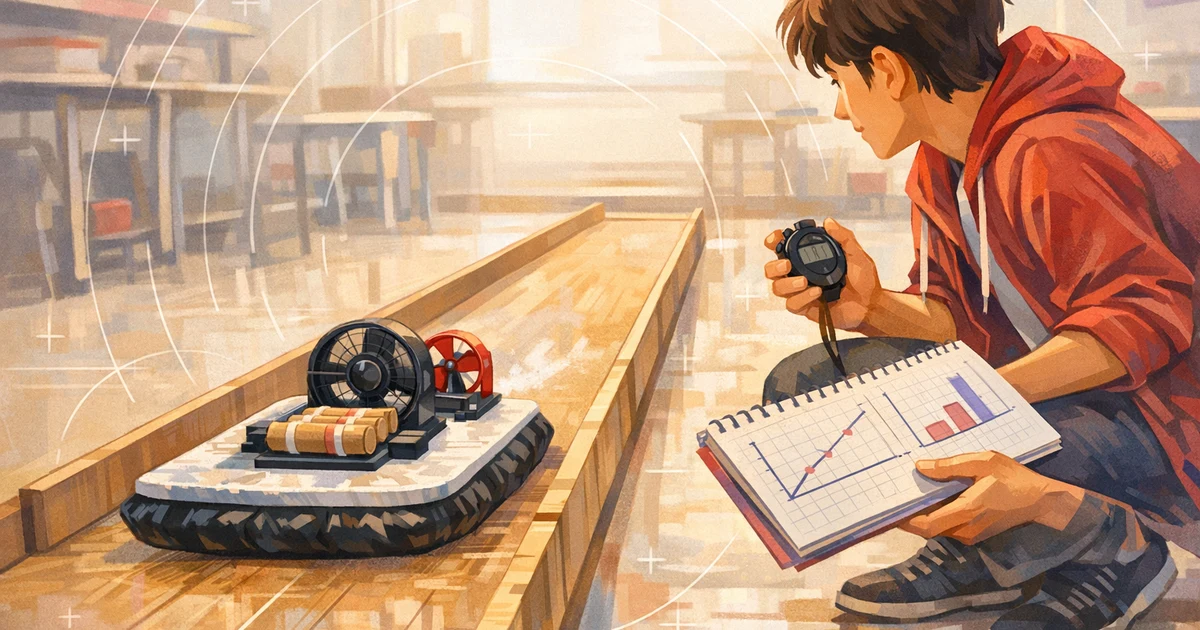
Science Olympiad Hovercraft is a build event in both Division B (middle school) and Division C (high school) for the 2027 season. Before the competition, you design, build and calibrate a self-propelled vehicle that floats on a cushion of air and carries nickels down a track. To do well, you need a craft that hovers reliably under load and a clear, tested understanding of how it behaves, so you can predict its run. This guide covers the physics, the electronics, and how to build, calibrate and practice.
What is Hovercraft?
Science Olympiad's official description for 2027, the same in both divisions: "Prior to the competition, participants will design, construct, and calibrate a self-propelled, air-levitated vehicle to carry nickels down a track."
Each word in that sentence is a job:
- Design and construct: you build the craft yourself, from the materials and electronics the rules allow.
- Calibrate: you measure how your craft performs under different settings and loads, so its behavior on the track is predictable rather than a surprise.
- Self-propelled: the craft moves under its own thrust.
- Air-levitated: it must ride on a cushion of air, not on wheels or runners.
- Carry nickels: it carries a payload of coins. A US nickel has a mass of 5.000 grams (US Mint), which makes payload math easy: 20 nickels add 100 grams.
How the run is timed and scored, the size limits, the track and the payload rules are all in the official 2027 rules. Download them free from the 2027 Rules page before you design anything.
How a hovercraft hovers: pressure times area
A hovercraft is an air-cushion vehicle. A fan pushes air into the space under the hull, and a flexible skirt traps it. The trapped air is at a slightly higher pressure than the air outside. When the upward force from that pressure equals the craft's weight, the craft lifts off the surface (DiscoverHover Curriculum Guide #4).
The key relationship is simple:
- Lift = cushion pressure × cushion area.
- So the pressure you need = weight ÷ cushion area.
An example shows how small the pressure is. Take a craft with a mass of 0.5 kg and a cushion area of 20 cm × 20 cm (0.04 m²):
- Weight = 0.5 kg × 9.81 m/s² = 4.905 N.
- Pressure needed = 4.905 N ÷ 0.04 m² ≈ 123 Pa.
- Normal air pressure is about 101,325 Pa, so the cushion needs only about 0.12% more pressure than the air around it.
Add 20 nickels (0.1 kg) and the pressure needed rises to about 147 Pa. Your lift system must hold that higher pressure, with the full payload, all the way down the track.
Embry-Riddle Aeronautical University's open textbook on aerospace vehicles makes the same point: slight pressure differences produce large lift forces when they act over large areas (Introduction to Aerospace Flight Vehicles, Ground Effect Vehicles). The design lesson: a larger, well-sealed cushion supports a load with less pressure, so your lift fan works less hard.
The skirt and the air gap
Air always leaks out under the edge of the skirt. The craft settles at the height where the air leaking out equals the air the fan pushes in. More fan power raises the craft, but a higher craft leaks more air, so the gain is limited (DiscoverHover; Embry-Riddle).
What this means for your build:
- Seal every seam. Leaks in the hull or skirt waste fan power.
- Center the load. The cushion pushes up over its whole area. If the nickels sit to one side, that side sinks and drags while the other side leaks air. Mount the payload over the center of the cushion.
- Test empty and fully loaded. A craft that hovers well when empty can drag when loaded.
How a hovercraft moves: thrust, mass and friction
Once the craft floats, friction with the track becomes very small. That is the whole point of a hovercraft, and it is why a small propeller can move it (NASA JPL Education, Hovering on a Cushion of Air).
Three ideas from introductory physics explain the run:
- Newton's third law. The propeller pushes air backward; the air pushes the propeller, and the craft, forward (OpenStax University Physics, 5.5 Newton's Third Law).
- Newton's second law. Acceleration = net force ÷ mass (OpenStax, 5.3 Newton's Second Law). With 0.2 N of thrust, a 0.5 kg craft accelerates at 0.4 m/s². Add 0.1 kg of nickels and it drops to about 0.33 m/s². More payload means a slower craft unless you add thrust.
- Friction and drag still matter. Small rubbing between skirt and track, or air resistance at higher speed, reduce the net force. Small, steady losses add up over the length of a track.
Some hovercraft use one fan for both lift and thrust, by splitting the airflow. Others use separate lift and thrust systems. A separate lift fan lets you tune hover height and speed independently, at the cost of a second motor's mass and power.
The electronics: only what is on the list
Science Olympiad published a free 2027 Hovercraft electronic components guide on the event page. Its key point: the rules contain an allowed list of electronic components, and "if a component is not explicitly allowed, then it is automatically disallowed."
According to that guide:
- Allowed examples: batteries (but not lithium or lead), wires and connectors, capacitors, up to two motors, potentiometers, mechanical switches, resistors, rheostats and relays.
- Disallowed examples: microcontrollers, lithium or lead batteries, transistors, diodes, LEDs, lasers, pulse-width modulation controllers, display screens and integrated circuit chips (unless built into a commercial motor).
The guide also gives a practical warning: check the power rating of every part. A power source the rules allow can still be too much for your circuit. Voltage limits, switch requirements and battery rules are in the official rules and the components guide, so read both.
This list shapes the whole design. With no microcontroller, you control speed and timing with simple analog parts, such as a potentiometer or rheostat to set motor speed. That makes careful calibration even more important.
How to calibrate your hovercraft
Calibration is where good teams pull ahead. The goal is to know, before you reach the track, how your craft will perform with a given setting and payload. Exactly how calibration and timing are scored is in the 2027 rules, so tailor your data to them. The method below is general.
- Build or borrow a practice track that matches the official track. The soinc.org Hovercraft page links to a guide for building a hovercraft track from a previous season.
- Choose your variables. Usually: thrust setting (for example a potentiometer position), payload (number of nickels) and starting position.
- Fix everything else. Use the same batteries at the same charge level, the same skirt and the same track surface. Battery charge is a hidden variable that can change your results from run to run.
- Run each setting several times and record the time for each run. Use the average, and note the spread. A large spread means your craft is not yet consistent.
- Plot your data. Graph time against distance, or time against payload, for each setting. A smooth curve lets you predict settings you did not test.
- Retest before every competition. Batteries, skirts and motors wear. Recheck a few points from your curve before each tournament.
Many teams keep a single lab notebook for the craft: every change, every run, every result. When an event supervisor asks how your craft works, that notebook is your answer.
Building it yourself
Science Olympiad's Building and Tools Policy says every device presented for judging must be built by students on the team. Adults may teach principles, tool safety and techniques, and suggest references, but no part of the device may be built or assembled by an adult. Event supervisors may question you in detail about how your device was designed and built.
If you can explain the physics in this guide using your own craft, you are ready for those questions.
Common problems and fixes
- The craft will not lift with the full payload. Check for leaks, increase cushion area within the size limit, or add lift airflow.
- The craft drifts into the rail. Check that the load is centered and that thrust points straight back. A small fin or a guide can help, if the rules allow it.
- Runs are inconsistent. Charge batteries the same way before every run, and check the skirt for wear or tears.
- The craft tips or scrapes on one side. Rebalance the payload over the center of the cushion.
Where Hovercraft leads
Hovercraft combines mechanical design, simple electronics and fluid physics. Science Olympiad's event page links to career guides for aerospace engineers and mechatronics engineers and technicians.
It is also a natural route into research. Questions such as "How does skirt material change the air gap and lift efficiency?" or "How does battery charge affect thrust?" are real experiments. For help turning a question into a project, see how to choose a research topic in high school and our science fair projects for high school. Middle school students can start with our science fair project ideas for middle school. For the full picture of the competition, read our Science Olympiad guide.
Frequently asked questions
What is Hovercraft in Science Olympiad? A build event in which you design, build and calibrate a self-propelled, air-levitated vehicle that carries nickels down a track.
Is Hovercraft a 2027 Science Olympiad event? Yes. Hovercraft is on the official 2027 event lists for both Division B and Division C.
How does a Science Olympiad hovercraft float? A fan pushes air under the hull and a skirt traps it. The trapped air is at slightly higher pressure than the air outside, and that pressure times the cushion area lifts the craft.
What electronics are allowed in Hovercraft? Only the components on the allowed list in the rules. Science Olympiad's free 2027 components guide says anything not explicitly allowed is disallowed, and gives examples such as no microcontrollers and no lithium or lead batteries.
How much do the nickels weigh? A US nickel has a mass of 5.000 grams, according to the US Mint.
What does "calibrate" mean in Hovercraft? Measuring how your craft performs at different settings and payloads, so you can predict its run. The rules explain how calibration and timing are scored.
Where can I get the official Hovercraft rules? From the 2027 Rules page on the Science Olympiad website. Check the Rules Corrections page too.
Sources
- Science Olympiad, Hovercraft event page
- Science Olympiad, 2027 Hovercraft Electronic Components (PDF)
- Science Olympiad, 2027 Event Table
- Science Olympiad, 2027 Rules
- Science Olympiad, Building and Tools Policy
- US Mint, Coin Specifications
- DiscoverHover, Curriculum Guide #4: Pressure and Lift
- Embry-Riddle Aeronautical University, Introduction to Aerospace Flight Vehicles: Ground Effect Vehicles
- NASA JPL Education, Hovering on a Cushion of Air
- OpenStax, University Physics Volume 1, 5.3 Newton's Second Law
- OpenStax, University Physics Volume 1, 5.5 Newton's Third Law
About learnSTEM
All bright students reach a point where school stops challenging them. learnSTEM provides that challenge: the space to explore a field of their choice, guided by a world-class PhD mentor from a top-20 university, completely one-on-one and on your own schedule. Students finish with a passion for a new subject, a research project they are proud of, and a clear sense of what they want to pursue next.
See if you qualify for the STEM Research Program → · Questions about eligibility? Contact us →
"It has only strengthened my love for learning about the world and given me a paper that I am proud to say I've made." — learnSTEM student
Admission deadlines
Early Admission – November 15, 2026
Regular Admission – December 13, 2026
Late Admission – January 31, 2027
The Program runs four times per year: Spring, Summer, Fall, and Winter.
