
Call us anytime
Science Olympiad Boomilever: The Physics, the 2027 Design Shift and How to Build

Last updated: October 31, 2026
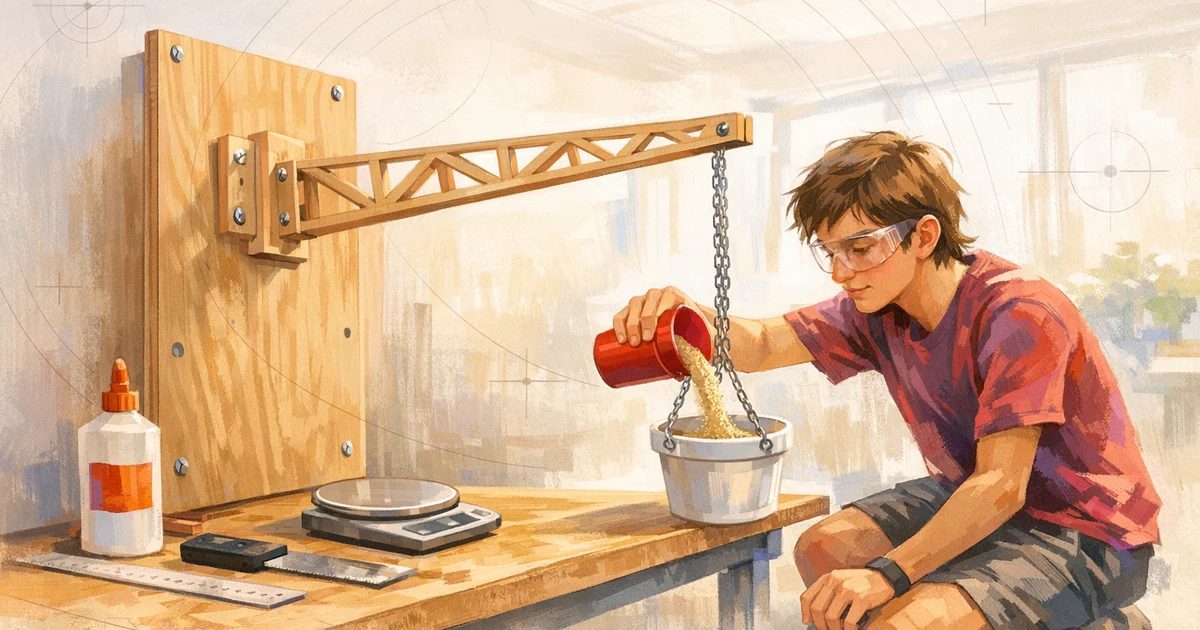
Science Olympiad Boomilever is a build event in both Division B (middle school) and Division C (high school) for the 2027 season. Before the tournament, you build a wooden cantilevered beam or truss that attaches to a vertical Testing Wall and holds a load at a set height and distance from the wall. Your score combines structural efficiency (how much load your structure holds for its own mass) and a Load Scored Bonus. This guide explains the physics that decides who wins, what changes for 2027 and how to build and test like an engineer.
What is Boomilever?
Science Olympiad describes the event this way: teams "build a cantilevered beam or truss structure that extends from a vertical Testing Wall and supports a load at a specified height and distance from the Testing Wall." The same description applies to Division B and Division C. The two divisions have different dimensional requirements, which are in each division's rules.
A cantilever is a structure that is supported at one end only. Diving boards, balconies and the arms of tower cranes are all cantilevers. Science Olympiad's own 2027 event overview points to one of the most famous cantilever bridges in the world, the Forth Bridge in Scotland, as an example of the idea at full scale.
On tournament day, your structure is weighed, mounted on the Testing Wall and loaded with a bucket that fills with sand until the structure reaches the maximum load or breaks. Every gram of wood you did not need lowers your score, and every gram of load you hold raises it.
How Boomilever is scored, in plain terms
The official description says the score is "a combination of structural efficiency and Load Scored Bonus." Science Olympiad's free 2027 event overview for students and coaches explains the core idea: structural efficiency is the load your structure held divided by the structure's mass.
That ratio is the whole game. The same overview compares it to nature: a human weightlifter lifts about twice their body mass and an ant more than 100 times its own, while these structures can reach ratios of up to about 4,000 to 1.
Two things follow from this:
- Mass matters as much as strength. A structure that holds 10% more load but weighs 20% more has a lower efficiency.
- There is a ceiling. The rules set a maximum load and the conditions for the bonus. Read them in the official rules before you design, because your target is not "as strong as possible." It is "strong enough to reach the maximum, at the lowest possible mass."
The exact maximum load, bonus conditions and tie-breakers are in the 2027 rules. Download them free from the 2027 Rules page and design to them.
The 2027 design shift: from tension to compression
The most important news for 2027 comes from Science Olympiad's own event overview. Boomilevers are named for the force in their longest member, the long diagonal of the triangle:
- Tension type: the long diagonal is pulled. The overview notes that 2026 National Tournament entries were tension-type designs.
- Compression type: the long diagonal is pushed. The overview says a 2027 rule change will drive compression-type Boomilevers, and that most 2026 designs will not meet the new requirement.
This matters because wood behaves very differently in each case. A thin stick is strong when you pull it. The same stick pushed from both ends bends sideways and snaps at a much lower load. That sideways failure is called buckling, and in 2027 it becomes the central problem of the event. If you built a Boomilever last season, expect to start from a fresh design.
The overview was written from draft rules. Always check the final 2027 rules and the official Rules Corrections before you build.
The physics behind a winning Boomilever
You don't need a university degree to do well, but the students who win understand four ideas from first-year engineering mechanics.
1. Tension and compression
When forces pull on a member and stretch it, the member is in tension. When forces squeeze it and shorten it, the member is in compression. Physicists measure both as stress: force divided by the cross-sectional area of the member (OpenStax University Physics, Section 12.3).
In a Boomilever truss, every member is mostly in tension or mostly in compression. Before you cut any wood, sketch your design and mark each member "T" or "C." That one habit changes how you size every piece.
2. Statics: forces must balance at every joint
A structure that holds still is in static equilibrium: the forces at every joint add up to zero. That lets you work out the force in each member from the load and the geometry, a method engineers call the method of joints.
The useful lesson for design is about angles. A steep diagonal carries less force than a shallow one for the same load. A shallow diagonal must carry more force, so it needs to be stronger and heavier. Changing the height where your structure meets the wall changes the angles, and so the forces, in every member.
3. Buckling: why compression members fail early
A long, slender member in compression can buckle at a load far below the load that would crush the wood. Engineers predict this with Euler's buckling formula. The key result is that the buckling load falls with the square of the member's unsupported length: double the length and the member buckles at one quarter of the load (Grohs, Strength of Materials, Chapter 15).
This is why compression members in strong structures are braced. A small cross-brace at the middle of a long compression member cuts its unsupported length in half. In theory, that raises its buckling load by about four times, for very little added mass. Shape matters too. A member that is stiff in only one direction will buckle in its weak direction, so a square or boxed cross-section often beats a flat strip of the same mass.
Science Olympiad's 2027 overview lists Euler's buckling formula among the core "design fundamentals" of the event. With compression-type designs, it is the formula to learn first.
4. Material properties and joints
Wood is a natural material, so two sticks of the same size can differ a lot in mass and stiffness. Science Olympiad's overview lists material inspection, wood screening and pairing, and bonding techniques as core build skills. In practice:
- Weigh every stick before you use it, and record the mass.
- Test stiffness by supporting a stick at both ends and checking how far it bends under a small weight.
- Pair matched sticks for the two sides of a symmetric structure, so one side doesn't fail first.
- Put your best stock where it matters most: stiff pieces in compression, light pieces in tension.
Joints are where many structures fail. A joint must carry the force from one member into the next without crushing, shearing or peeling. Clean, square cuts and full contact between surfaces make joints stronger. The soinc.org Boomilever page includes a free presentation on joints from earlier seasons.
How to build and test, step by step
Think of each Boomilever as an experiment, not a craft project. Science Olympiad's overview lists "design of experiments," "root cause / corrective action" and "repeatability" as part of the event, and the teams that improve fastest work that way.
- Read the rules twice. Note every dimensional requirement for your division, the mounting method, the loading method and the bonus conditions. Make a checklist.
- Start from a known design. The soinc.org Boomilever page offers a free 2027 template and a build-and-test video. Building the template once teaches you the test setup and gives you a baseline score.
- Build a test rig. You need a wall that matches the official Testing Wall, a mounting bolt, a loading block, a bucket and sand, and a scale. The rules and the free overview show the test apparatus.
- Change one thing at a time. Change the bracing, or the wood, or the joint design, but not all three at once. Otherwise you won't know which change helped.
- Test to failure, and watch closely. Film every test in slow motion if you can. Note where the failure started: a member buckling, a joint opening or the wall attachment slipping.
- Log everything. Mass, load held, efficiency, where it broke and what you will change next. A simple spreadsheet is enough.
- Fix the weakest link, then remove mass from everything else. A structure that breaks in many places at nearly the same load is close to optimal. A structure that breaks at one obvious point has mass in the wrong places.
- Build tournament copies with the same care. Your competition structure should be a copy of your best tested design, built from matched wood.
Some teams also use structural analysis software to estimate member forces before they build. Science Olympiad lists a cloud-based structural tool with a Science Olympiad mode on its Boomilever page. Software helps you compare designs quickly, but only real tests tell you how your wood and joints behave.
Building it yourself: the rule that matters most
Science Olympiad's Building and Tools Policy says every device presented for judging must be built by students on the team. Adults may teach principles, show how to use tools safely, ask questions and suggest references, but no part of the device may be built or assembled by an adult. Event supervisors may question you in detail about your design and how you built it.
Treat this as an opportunity. If you can explain why each member is the size it is, you understand your structure better than anyone in the room.
Tournament-day checklist
- Carry your Boomilever in a padded box. Many teams also build a backup in case of damage in transit.
- Bring only the tools and supplies the rules allow.
- Check your structure against your rules checklist before you check in.
- Know your structure's mass and your expected load before the test.
- After the test, write down what happened while you remember it. It is data for your next design.
Where Boomilever leads
Boomilever is a small version of what structural and civil engineers do every day: choose a form, predict the forces, select materials and test the result. The soinc.org Boomilever page links to career guides for civil and mechanical engineering.
The skills also carry into research. A question such as "How does bracing position change the buckling load of a slender wood member?" is a real experiment with variables, controls and data. For ideas on turning a question like that into a project, see our guides to science fair projects for high school and how to choose a research topic in high school. If you enjoy engineering, our list of summer engineering programs for high school students is another next step. For a full overview of the competition, the other events and how tournaments work, read our Science Olympiad guide.
Frequently asked questions
What is Boomilever in Science Olympiad? A build event in which you design and build a wooden cantilevered beam or truss that attaches to a vertical Testing Wall and holds a load at a set height and distance. Your score combines structural efficiency and a Load Scored Bonus.
Is Boomilever a 2027 Science Olympiad event? Yes. Boomilever is on the official 2027 event lists for both Division B and Division C.
How is structural efficiency calculated? Science Olympiad's free 2027 event overview defines it as the load your structure held divided by the structure's mass. The official rules set the maximum load, bonus conditions and tie-breakers.
What changed for Boomilever in 2027? Science Olympiad's 2027 event overview says a rule change will drive compression-type designs, where the long diagonal member is pushed rather than pulled. 2026 National Tournament entries were tension-type designs.
What is the hardest part of Boomilever? For 2027, buckling. Long compression members fail sideways at loads far below the wood's crushing strength. Bracing, member shape and careful wood selection control it.
Can a parent or coach help build a Boomilever? Adults may teach principles, tool use and safety, but students must build and assemble the device themselves. Event supervisors may question students about their design and construction.
Where can I get the official Boomilever rules? From the 2027 Rules page on the Science Olympiad website. Always check the official Rules Corrections too.
Sources
- Science Olympiad, Boomilever event page
- Science Olympiad, 2027 Boomilever Event overview for students and coaches (PDF)
- Science Olympiad, 2027 Event Table
- Science Olympiad, C Event Short Descriptions
- Science Olympiad, 2027 Rules
- Science Olympiad, Rules Corrections
- Science Olympiad, Building and Tools Policy
- OpenStax, University Physics Volume 1, 12.3 Stress, Strain, and Elastic Modulus
- Grohs, Strength of Materials, Chapter 15: Columns
About learnSTEM
All bright students reach a point where school stops challenging them. learnSTEM provides that challenge: the space to explore a field of their choice, guided by a world-class PhD mentor from a top-20 university, completely one-on-one and on your own schedule. Students finish with a passion for a new subject, a research project they are proud of, and a clear sense of what they want to pursue next.
See if you qualify for the STEM Research Program → · Questions about eligibility? Contact us →
"It has only strengthened my love for learning about the world and given me a paper that I am proud to say I've made." — learnSTEM student
Admission deadlines
Early Admission – November 15, 2026
Regular Admission – December 13, 2026
Late Admission – January 31, 2027
The Program runs four times per year: Spring, Summer, Fall, and Winter.
